

Linear Equation Solver: Solve Linear Equations Quickly and Understand Every Step
A Linear Equation Solver is a useful resource for anyone who wants to solve algebra problems quickly and improve their understanding of mathematics.

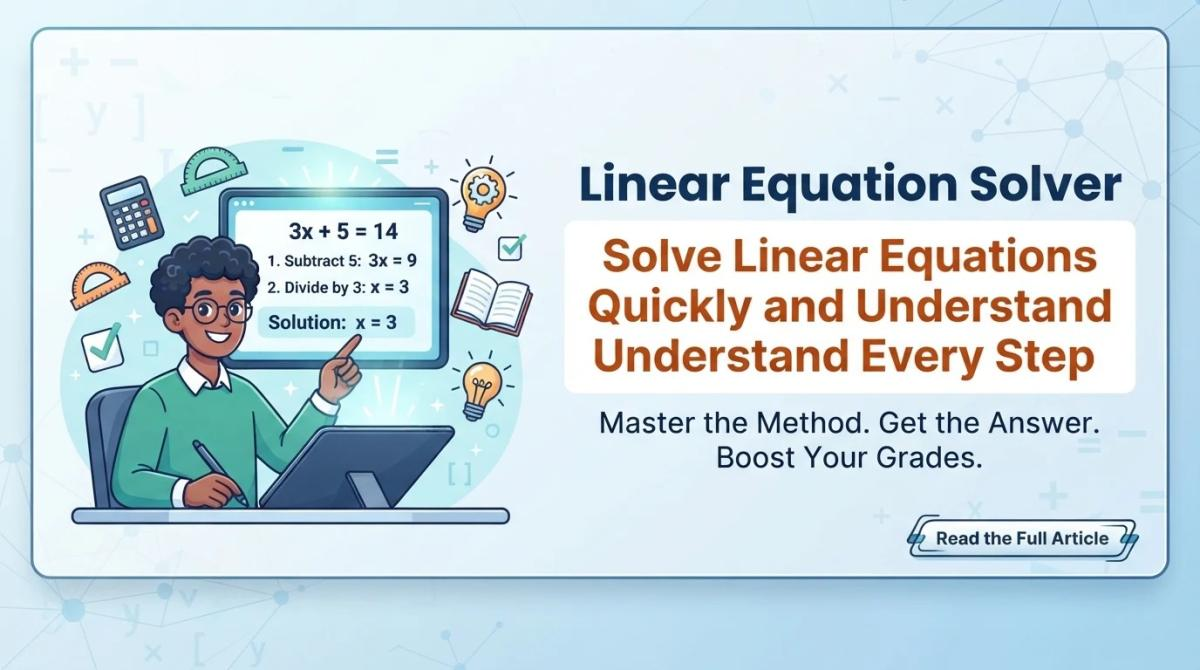
Solving mathematical equations can sometimes be challenging, especially when they involve multiple variables, fractions, negative numbers, or complex calculations. A Linear Equation Solver makes this process easier by helping students, teachers, and professionals find accurate solutions without spending unnecessary time on manual calculations.
Whether you are learning basic algebra, preparing for an examination, or working on mathematical problems, a linear equation solver can help you understand how equations work and how to solve them step by step.
Linear equations are an important part of mathematics because they are used in algebra, geometry, economics, engineering, physics, and many other subjects. Understanding how to solve them builds a strong foundation for learning more advanced mathematical concepts.
What Is a Linear Equation?
A linear equation is a mathematical statement in which variables have a maximum exponent of one. It represents a relationship between numbers and variables, usually written in the form:
[
ax+b=0
]
Here:
-
(a) represents the coefficient of the variable.
-
(x) represents the unknown variable.
-
(b) represents a constant number.
-
(a) must not equal zero for this equation to have a unique solution.
For example:
[
3x+6=15
]
To solve this equation, subtract 6 from both sides:
[
3x=15-6
]
[
3x=9
]
Now divide both sides by 3:
[
x=3
]
The answer is 3. A linear equation solver can perform these calculations and help users understand the mathematical process.
How Does a Linear Equation Solver Work?
A linear equation solver uses mathematical rules and calculation methods to determine the unknown value in an equation. Users enter an equation into the calculator, and the tool processes the mathematical expression to identify its solution.
Depending on the available features, an online solver may also display the individual steps involved in reaching the final answer.
For example, consider the following equation:
[
5x-10=20
]
The solving process includes:
Step 1: Add 10 to both sides.
[
5x=20+10
]
Step 2: Simplify the equation.
[
5x=30
]
Step 3: Divide both sides by 5.
[
x=6
]
The final answer is (x=6).
Using a linear equation solver can reduce calculation time and make it easier to check answers, particularly when working with several mathematical problems.
Benefits of Using an Online Linear Equation Solver
Online equation-solving tools provide several advantages for people who regularly work with algebra and mathematical calculations.
1. Saves Time
Solving equations manually can take time, particularly when calculations involve multiple operations. An online solver can provide results quickly, allowing users to focus on understanding the concepts and completing their assignments.
2. Helps Students Understand Algebra
Students often struggle with algebra because they find it difficult to understand how mathematical operations are connected. A step-by-step solver can demonstrate how to isolate variables and simplify equations.
3. Reduces Calculation Errors
Small mistakes involving addition, subtraction, multiplication, or division can lead to incorrect answers. A reliable solver helps users check their calculations and identify possible errors.
4. Supports Independent Learning
Students can use equation solvers to practise different types of problems outside the classroom. They can compare their handwritten solutions with the calculator's results to improve their understanding.
5. Easy to Access
Web-based mathematical tools can be accessed through computers, tablets, and smartphones. Users generally do not need specialised software to solve basic linear equations online.
Different Types of Linear Equations You Can Solve
Linear equations appear in several forms, depending on the number of variables and how mathematical expressions are arranged.
One-Variable Linear Equations
These equations contain one unknown variable, such as:
[
2x+8=18
]
The objective is to find the value of (x) that makes both sides equal.
Two-Variable Linear Equations
These equations contain two variables and are commonly written as:
[
2x+3y=12
]
A single equation with two variables generally has multiple solutions. Additional information, such as another independent equation, is needed to find a unique solution.
Linear Equations in Standard Form
A standard linear equation can be written as:
[
Ax+By=C
]
This format is commonly used when solving systems of linear equations and studying relationships between variables.
Systems of Linear Equations
A system contains two or more linear equations that must be solved together. Common methods include substitution, elimination, and graphical methods.
Understanding these different forms helps students recognise which solving method is appropriate for a particular problem.
Practical Applications of Linear Equations
Linear equations are not limited to classroom exercises. They are used in many everyday situations and professional fields.
-
Business and Finance: Calculating expenses, revenue, profit, and pricing relationships.
-
Engineering: Working with measurements, technical relationships, and basic design calculations.
-
Physics: Understanding relationships between distance, speed, and time under constant conditions.
-
Economics: Analysing supply, demand, and financial relationships.
-
Education: Teaching algebraic concepts and developing mathematical problem-solving skills.
Learning how to solve linear equations can therefore provide useful skills for both academic studies and practical decision-making.
Tips for Solving Linear Equations Correctly
Although online calculators make calculations easier, learning the correct solving process remains important.
-
Simplify both sides of the equation before performing further calculations.
-
Combine similar terms wherever possible.
-
Move variable terms to one side and constants to the other.
-
Use inverse operations to isolate the unknown variable.
-
Divide or multiply carefully to find the final answer.
-
Substitute the answer into the original equation to verify that both sides are equal.
Following these steps can help you develop stronger algebra skills and solve equations more confidently.
Frequently Asked Questions (FAQs)
1. What is a linear equation solver?
A linear equation solver is an online mathematical tool that calculates the unknown values in linear equations. It can help users solve algebra problems and, depending on its features, display step-by-step calculations.
2. How do I solve a linear equation?
To solve a linear equation, simplify both sides, move constants and variable terms using inverse operations, and isolate the unknown variable. Finally, substitute the answer into the original equation to check your result.
3. Can I solve linear equations with two variables?
Yes. Linear equations with two variables can be solved using methods such as substitution, elimination, and graphing. However, you generally need two independent equations to find a unique solution.
4. Is an online linear equation solver useful for students?
Yes. Students can use online solvers to check homework, practise algebra, understand calculation methods, and identify mistakes in their working.
5. Can a linear equation solver show step-by-step solutions?
Some online calculators provide detailed explanations showing how an equation is simplified and solved. However, available features depend on the specific tool.
6. What is the standard form of a linear equation?
The standard form of a linear equation with two variables is (Ax+By=C), where A, B, and C are constants. For a single variable, a common standard form is (ax+b=0).
7. Are linear equations used in real life?
Yes. Linear equations are used in business calculations, engineering, physics, economics, budgeting, and many other practical situations involving relationships between quantities.
Conclusion
A Linear Equation Solver is a useful resource for anyone who wants to solve algebra problems quickly and improve their understanding of mathematics. From simple one-variable equations to more advanced systems of linear equations, these tools can make mathematical calculations easier and more manageable.
By combining online solving tools with regular practice, students can develop stronger problem-solving skills, reduce calculation mistakes, and build confidence in algebra. Whether you are completing homework, preparing for an examination, or learning mathematics independently, understanding linear equations is an important step towards mastering more advanced mathematical topics.
















Comments (0)