

Supply Chain Management vs Logistics: What's the Difference?
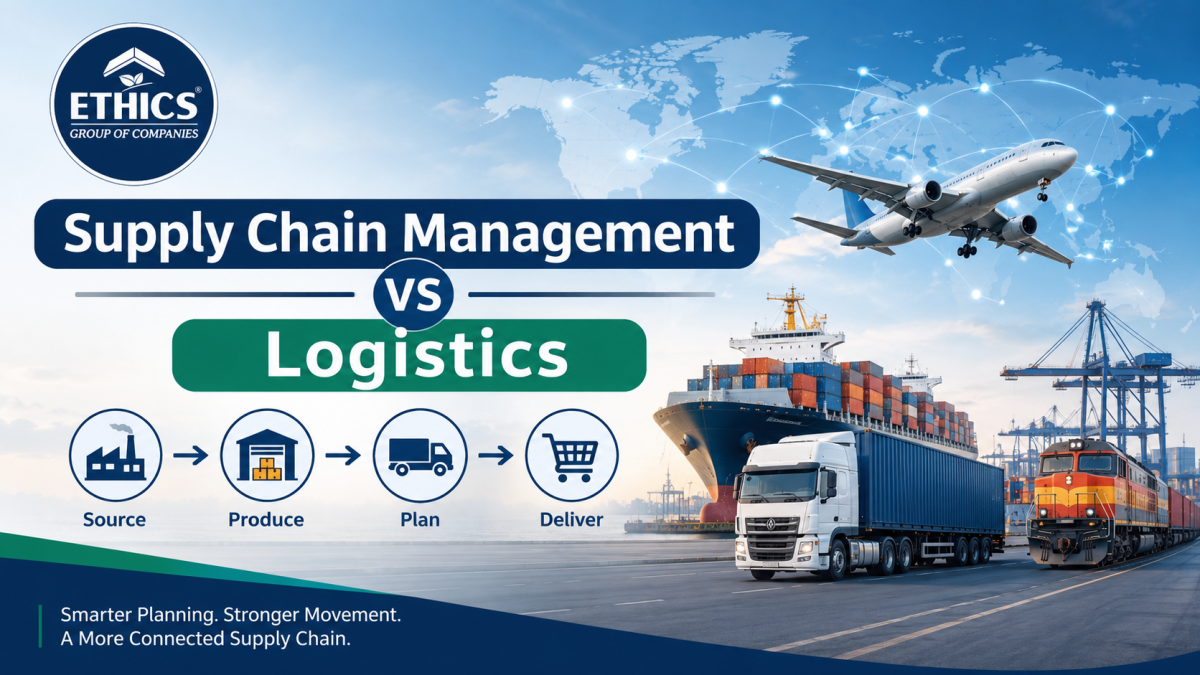
People often use "supply chain management" and "logistics" as if they mean the same thing. They are closely related, but they are not identical. Understanding the difference helps you organise your teams, choose the right partners and improve performance.
What Is Logistics?
Logistics is the part of the process that deals with moving and storing goods. It covers transportation, warehousing, inventory handling, packaging, order fulfilment and delivery. Its goal is to get the right product to the right place at the right time, at the right cost.
What Is Supply Chain Management?
Supply chain management (SCM) is broader. It covers the entire network involved in turning raw materials into finished products and delivering them to customers. This includes sourcing, procurement, manufacturing, demand planning, supplier relationships, logistics and even returns. SCM is about coordinating all these parts so they work together.
In simple terms: logistics is one component of supply chain management.
Key Differences at a Glance
| Aspect | Logistics | Supply Chain Management |
|---|---|---|
| Scope | Movement and storage of goods | Entire end-to-end network |
| Focus | Efficiency of delivery | Overall value and coordination |
| Time horizon | Mostly operational, short term | Strategic and long term |
| Activities | Transport, warehousing, distribution | Sourcing, planning, production, logistics, returns |
| Key partners | Carriers, warehouse operators | Suppliers, manufacturers, logistics providers, retailers |
| Typical goal | Timely, low-cost delivery | Resilience, cost, service and growth |
Where They Overlap
Both aim to satisfy the customer while controlling cost. Both rely on good data, strong partner relationships and sound planning. A delay in logistics affects the whole supply chain, and a poor supply chain plan creates logistics chaos, such as rushed shipments and overflowing warehouses.
A Real-World Illustration
Imagine a company selling packaged foods. Logistics decides how trucks move goods from the factory to warehouses and then to retailers, and how stock is stored and dispatched. Supply chain management and Logistics goes further. It decides which suppliers provide ingredients, how much to produce, where to place inventory across the country, how to handle demand spikes and how to manage risk if a supplier fails.
Why the Difference Matters
- Organisation: Treating logistics as the whole picture can leave sourcing, planning and supplier risk unmanaged.
- Hiring and skills: Logistics roles are operations-heavy. Supply chain roles need strategic, analytical and cross-functional skills.
- Choosing partners: A logistics provider handles movement and storage. An integrated supply chain partner can help design the whole network.
- Measuring performance: Logistics metrics include on-time delivery and cost per shipment. Supply chain metrics include inventory turns, order cycle time, supplier reliability and total landed cost.
Which Do You Need?
If your main pain points are late deliveries, high transport costs or warehouse errors, start with logistics improvements. If you face stockouts alongside excess inventory, supplier delays, forecasting problems or rising overall costs, you need a supply chain approach that looks at the whole network.
Many growing businesses need both. Strong logistics execution inside a well-designed supply chain strategy is what delivers lasting results.
Conclusion
Logistics moves and stores goods. Supply chain management connects every step from supplier to customer. Knowing where one ends and the other begins lets you invest in the right capabilities, ask better questions of your partners and build a more resilient business.
Ethics Group offers integrated supply chain and logistics services for Indian businesses.
Established in 2009, Ethics Group is a diversified business group delivering innovative, technology-driven solutions across supply chain management, logistics, warehousing, distribution, retail, fintech, information technology, infrastructure, aviation, and tourism. With a strong focus on operational excellence, innovation, and customer satisfaction, we help businesses streamline operations, optimize resources, and achieve sustainable growth. Our integrated approach combines industry expertise, advanced technology, and customized solutions to address evolving business challenges. At Ethics Group, we are committed to building efficient, scalable, and future-ready business ecosystems through strong partnerships and continuous innovation. https://ethicsgroup.in/

















Comments (0)