

AI in Supply Chain: How Artificial Intelligence Is Changing Planning, Warehousing and Delivery
Discover how artificial intelligence in supply chain management helps businesses improve demand forecasting, inventory, logistics, warehousing and overall operational efficiency.
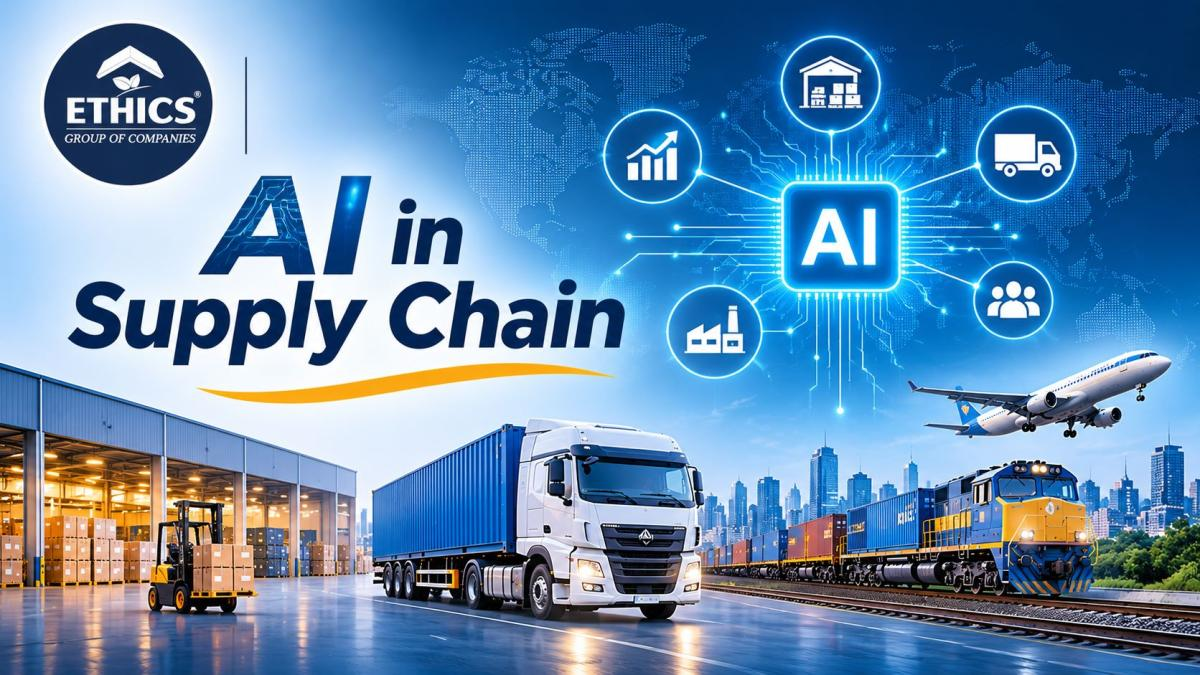
Supply chains generate enormous amounts of data, from orders and stock levels to truck locations and supplier lead times. Most of it goes unused. AI in supply chain management changes that by turning raw data into predictions and decisions, often faster and more accurately than manual methods.
What Does AI in Supply Chain Mean?
It means using machine learning, predictive analytics and automation to improve how goods are planned, stored, moved and delivered. It does not replace supply chain professionals. It gives them better information, earlier warnings and less repetitive work.
Where AI Delivers the Most Value
1. Demand forecasting. Traditional forecasts rely on past sales. AI models can also consider seasonality, promotions, pricing, weather and market trends. Better forecasts mean less stockout risk and less excess inventory.
2. Inventory optimisation. AI can suggest how much stock to hold at each location and when to reorder. This frees up working capital while keeping service levels steady.
3. Warehouse operations. AI supports smarter slotting, labour planning and pick-path optimisation. Combined with robotics and scanning systems, it reduces errors and speeds up order processing.
4. Route and transport optimisation. Algorithms can plan routes using traffic, delivery windows, vehicle capacity and fuel cost. This lowers transport spend and improves on-time delivery.
5. Supplier risk and visibility. AI can flag delays, quality issues or disruptions early, giving planners time to react instead of firefight.
6. Predictive maintenance. Sensors and models can predict equipment or vehicle failures before they cause downtime.
A Simple Example
Consider an FMCG distributor serving hundreds of retail outlets. Without AI, planners reorder based on last month's sales and gut feel. With AI-driven forecasting, the system notices that a festival is approaching, a regional promotion is running and a competitor's stock is thin. It recommends higher stock in specific locations ahead of time. The result is fewer empty shelves and fewer unsold goods.
Challenges to Expect
- Data quality: AI is only as good as the data behind it. Duplicate, missing or delayed data leads to poor predictions.
- Legacy systems: Older software may not connect easily with modern tools.
- Skills and change management: Teams need training and trust in the system.
- Unrealistic expectations: AI improves decisions but cannot fix a broken process on its own.
How to Get Started
- Fix the data foundation. Clean up product, inventory and order data first.
- Pick one high-value problem. Demand forecasting or route planning are common starting points.
- Run a small pilot. Measure results against your current method.
- Keep humans in the loop. Planners should review and override AI recommendations, especially early on.
- Scale gradually. Expand only after the pilot proves its value.
The Road Ahead
As tools become more affordable, AI is no longer limited to large enterprises. Mid-sized businesses can use cloud-based forecasting, visibility and optimisation platforms without building their own data science teams. The companies that benefit most will be those that combine good data, clear goals and experienced supply chain judgement.
Conclusion
AI in supply chain is a practical way to forecast better, hold smarter inventory and deliver more reliably. Start small, focus on one problem and build from there.
Ethics Group supports businesses with end-to-end supply chain solutions, from warehousing to distribution.
Established in 2009, Ethics Group is a diversified business group delivering innovative, technology-driven solutions across supply chain management, logistics, warehousing, distribution, retail, fintech, information technology, infrastructure, aviation, and tourism. With a strong focus on operational excellence, innovation, and customer satisfaction, we help businesses streamline operations, optimize resources, and achieve sustainable growth. Our integrated approach combines industry expertise, advanced technology, and customized solutions to address evolving business challenges. At Ethics Group, we are committed to building efficient, scalable, and future-ready business ecosystems through strong partnerships and continuous innovation. https://ethicsgroup.in/


















Comments (0)